CleanBC Heat Pump Rebate 2026 Guide
British Columbia offers some of Canada's most generous heat pump incentives — but the program structure changed significantly in 2025. Rebates are now split into two income-based streams, and there are critical steps (pre-registration, contractor requirements) that can disqualify you if you skip them. This guide covers the accurate 2026 picture.
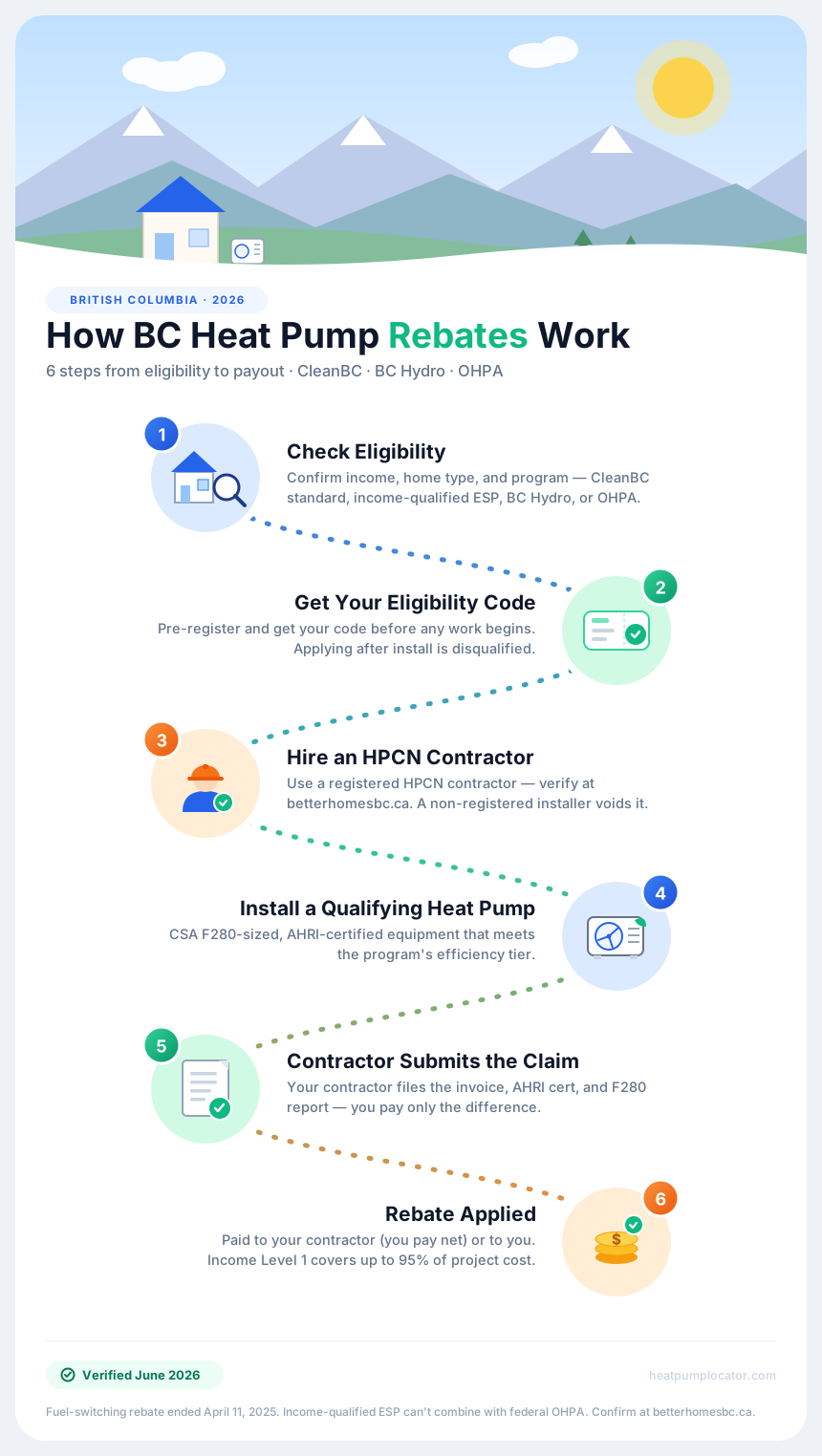
The 6 steps from eligibility to payout. The two that trip people up most: getting your Eligibility Code before any work begins, and using an HPCN-registered contractor.
Two Rebate Streams: Standard and Income-Qualified
CleanBC heat pump rebates no longer depend primarily on system type. They depend on your household income and property assessed value.
Stream 1 — Standard Rebates (no income test)
Available to any eligible BC homeowner regardless of income.
| Path | Rebate Amount |
|---|---|
| Electric resistance heat → heat pump meeting 100% of heating needs at −5°C | Up to $4,000 (BC Hydro) |
| Electric resistance heat → heat pump covering ≥50% of heating load | $1,500 partial rebate |
| Gas-heated home → dual-fuel heat pump | No longer available (FortisBC dual-fuel rebate, as of October 2026) |
Important: The fuel-switching rebate for homes heated by natural gas, oil, or propane ended April 11, 2025. Most competitor pages still advertise it — if a website or contractor quotes you a CleanBC fuel-switching rebate in 2026, the information is out of date. The FortisBC dual-fuel rebate that followed it is also no longer available (as of October 2026), and FortisBC's Residential Hybrid Heating Early Adopter Pilot has closed recruitment — so gas-heated homes currently have no standard-stream heat pump rebate. Income-qualified households can use the Energy Savings Program below or FortisBC's income-qualified dual-fuel rebate (see Stacking with FortisBC); everyone else pays full price, unless the household qualifies for the federal no-cost CGHAP direct-install program. Ground-source (geothermal) amounts are set separately — confirm current figures at betterhomesbc.ca.
Stream 2 — Income-Qualified Rebates (Energy Savings Program)
Significantly higher rebates for households that meet income thresholds. Maximums are set per upgrade category — rebates cover 100% of eligible costs, up to the cap, and caps are highest at Income Level 1 (lowest income).
| Upgrade | Maximum Rebate |
|---|---|
| Heat pump — ground-oriented home (house, duplex, townhome), replacing gas, propane or oil | Up to $13,000 |
| Heat pump — ground-oriented home, replacing electric heat (Income Level 1 only) | Up to $5,000 |
| Heat pump — condo/apartment suite (MURB up to 6 storeys) | Up to $5,000 |
| Heat pump water heater | Up to $3,500 |
| Windows and doors | Up to $9,500 |
| Insulation | Up to $5,500 |
The $13,000 heat pump maximum is the Income Level 1 amount for a fossil-fuel conversion in a ground-oriented home using a central ducted, multi-split (or two single-head mini-splits) or air-to-water system. Level 2 is up to $7,000 and Level 3 up to $3,500. Single-head mini-splits rebate less ($7,000 / $5,000 / $3,000). Electric-heated homes get up to $5,000 at Level 1 only — Levels 2 and 3 get nothing for electric-to-heat-pump, so they should use BC Hydro's $4,000 standard rebate. Wood-heated homes get up to $5,000 (Level 1) or $4,000 (Level 2). Each category above is a separate maximum — they do not add up to one headline number.
Add-on rebates also exist for ventilation, health & safety measures, and electrical service upgrades — amounts vary; see the official rebate pages at betterhomesbc.ca.
Northern BC top-up: Homes located in or north of the District of 100 Mile House get $3,000 extra at Levels 1 and 2 ($1,500 for a single-head mini-split; none at Level 3) — so a Level 1 fossil-fuel conversion in Prince George, Quesnel or Williams Lake can reach $16,000.
Income levels (combined pre-tax income of all adults in the household):
- Level 1 — highest rebate caps (100% of eligible costs, up to the cap)
- Level 2 — lower caps; no electric-to-heat-pump rebate
- Level 3 — applies only to gas/propane/oil → heat pump switches in ground-oriented homes
Income-qualified eligibility requirements:
- Household income must fall within provincial thresholds (see income table at betterhomesbc.ca)
- Property assessed value cap applies: $1.2M or less (Levels 1–2), $1.82M or less (Level 3)
- Must pre-register and receive an Eligibility Code BEFORE any installation work begins (see below)
- The rebate is paid directly to your contractor — you pay only the difference. This is how Level 1 households get near-zero-cost installations.
- The federal OHPA grant closed to new applications July 31, 2026 — oil/propane homes now route through ESP or the federal no-cost CGHAP direct-install program.
Income-qualified figures verified October 2026 against betterhomesbc.ca.
The Two Non-Negotiable Requirements
1. HPCN-Registered Contractor — No Exceptions
Your contractor must be registered with the BC Home Performance Contractor Network (HPCN). This applies to both streams.
If your contractor is not HPCN-registered, you receive no rebate — regardless of system quality, installation workmanship, or equipment efficiency. This is the most common reason homeowners lose their rebate eligibility after installation.
Before signing any contract, verify your contractor's HPCN registration at the BC government's Better Homes website. Do not rely on the contractor's self-report — look them up directly.
2. Pre-Registration and Eligibility Code (Income-Qualified Stream)
If you are applying under the income-qualified Energy Savings Program:
- You must pre-register with CleanBC before work begins or any equipment is paid for
- CleanBC issues an Eligibility Code — valid for 3 months and reusable across multiple ESP upgrades
- Installation proceeds only after you hold that code
- Systems installed before receiving the Eligibility Code are ineligible for the income-qualified rebate — applying after install is an automatic disqualification
This is not a formality — it is a hard cutoff. The code confirms your eligibility was verified before the work, not retroactively. Applications and invoices are due within 6 months of the invoice date.
For the standard stream, pre-registration is not required, but confirming contractor HPCN status before booking is strongly recommended.
How to Apply — Step by Step
Step 1: Check which stream you qualify for Estimate your household income relative to BC thresholds. If potentially income-qualified, start the pre-registration process immediately — before getting quotes.
Step 2: Income-qualified only — register and get your Eligibility Code Visit betterhomesbc.ca and submit your pre-registration. Do not book installation until the code arrives.
Step 3: Get quotes from HPCN-registered contractors only Verify HPCN registration for every contractor you consider. Request a CSA F280 heating load calculation — this is the Canadian standard (not US Manual J) and is required to confirm correct system sizing.
Step 4: Installation Your HPCN-registered contractor installs the system and collects all required documentation: AHRI certification, F280 load calculation, installation photos, and proof of old system decommissioning if applicable.
Step 5: Submit rebate application Standard stream: your contractor typically submits within 30 days of installation. Income-qualified stream: submit using your Eligibility Code.
Step 6: Rebate payment Processing typically takes 6–10 weeks. Payment goes directly to the homeowner.
Stacking with FortisBC
There is currently nothing to stack. FortisBC's standard dual-fuel heat pump rebate is no longer available (as of October 2026), and the Residential Hybrid Heating Early Adopter Pilot that followed it has closed recruitment and is not accepting applications. If you don't income-qualify, don't factor a FortisBC heat pump rebate into your budget — if a contractor quotes one, ask them to show you where it's currently offered on fortisbc.com.
The one exception is income-qualified — and it's an alternative, not a stack. FortisBC's income-qualified dual-fuel rebate pays up to $8,000 (plus a $350 bonus with a second qualifying upgrade) for a new central ducted air-source heat pump plus a new high-efficiency gas furnace and a connected thermostat. It cannot be combined with any other FortisBC, provincial or federal rebate, so an income-qualified gas home chooses one:
- Energy Savings Program: full switch to a heat pump, up to $13,000 at Income Level 1.
- FortisBC income-qualified dual-fuel: keep a new gas furnace as backup, up to $8,000.
FortisBC's requirements: residential FortisBC gas or propane customer; household income under the limits (the same as ESP Level 1 — e.g. $51,100 for one person, $94,900 for four); home at least 10 years old and no more than 3,500 sq ft (single-family, duplex, triplex, row/townhome, or mobile home on a foundation); assessed value under $1.2M; the existing gas furnace must be the primary heat source and at least 15 years old; installed by a Technical Safety BC–licensed gas contractor who is in the HPCN; apply within 6 months of the invoice; one per home.
Canada Greener Homes Programs
Canada Greener Homes Grant — CLOSED
The Canada Greener Homes Grant closed January 20, 2026 and is no longer accepting applications. Do not rely on any source that lists it as available.
Canada Greener Homes Loan — CLOSED
The Canada Greener Homes Loan closed to new applications October 1, 2025. Do not plan a project around it.
Canada Greener Homes Affordability Program (CGHAP) — Active
CGHAP delivers no-cost direct-install retrofits (including heat pumps) for low-to-median-income households — renters are eligible. It is not a rebate: the work is done for you. It has been delivering in BC since June 2026. Apply through nrcan.gc.ca.
System Requirements
Regardless of which stream you use, your heat pump must meet these standards:
- AHRI certification required
- Sized according to CSA F280 heating load calculation for your home and location
- Installed by an HPCN-registered contractor
- Air source: minimum HSPF 9.0 (cold-climate rated for interior BC)
- Ground source: minimum COP 3.0
Oversized systems can disqualify you. The F280 calculation, done by a qualified contractor, determines the correct capacity.
Frequently Asked Questions
My home is heated by natural gas. Am I eligible?
As of April 11, 2025, the fuel-switching rebate for gas, oil, and propane homes has ended under the standard stream. FortisBC's dual-fuel rebate is also no longer available (as of October 2026), so there is currently no standard-stream rebate for gas-heated homes. You may still qualify under the income-qualified Energy Savings Program (up to $13,000 at Income Level 1 for a ground-oriented home) if your household meets the income and property value thresholds — pre-register for an Eligibility Code before any work. Income-qualified FortisBC customers can instead choose FortisBC's income-qualified dual-fuel rebate (up to $8,000, heat pump plus new gas furnace) — one or the other, not both. Low-to-median-income households may also qualify for CGHAP no-cost direct-install retrofits. Verify at betterhomesbc.ca.
My home has electric baseboard heaters. Am I eligible?
Yes. Electric resistance heating (baseboard, ceiling heaters, electric furnaces) qualifies under the standard stream for a BC Hydro rebate of up to $4,000 when the heat pump meets 100% of the home's heating needs at −5°C ($1,500 at ≥50% of heating needs). Under the income-qualified Energy Savings Program, electric-heated homes get up to $5,000 for a heat pump — Income Level 1 only; Levels 2 and 3 get nothing for electric-to-heat-pump. (The $13,000 maximum applies only to gas, propane or oil conversions.) Rebates cover 100% of eligible costs, up to the cap. A heat pump water heater adds up to $3,500 as a separate category.
Can I choose any licensed HVAC contractor?
No. Your contractor must be HPCN-registered. A licensed HVAC contractor who is not on the HPCN list will not qualify you for the rebate.
Is a home energy audit required?
Not for CleanBC rebates. The Canada Greener Homes Loan, which required an EnerGuide assessment, closed to new applications October 1, 2025.
How long does the rebate take?
Standard processing is 6–10 weeks after a complete application is submitted. Ensure your contractor submits all required documentation — incomplete applications are the main cause of delays.
Can I start work before getting approval?
Standard stream: work can proceed, but HPCN contractor verification should happen first. Income-qualified stream: No. You must hold your Eligibility Code before work begins. There are no exceptions.
Before You Count On That Rebate, Check Your Panel
A heat pump install that triggers an electrical panel upgrade adds $2,000–$5,000 — and the contractor quoting it profits either way. Most 200A panels pass. Many 100A panels don't. Find out in 3 minutes with the same CEC Rule 8-200 math your electrician uses, before anyone quotes you.
If you're income-qualified, the Energy Savings Program also offers an electrical service upgrade add-on rebate — so knowing whether you actually need the upgrade before you apply keeps your application clean and your quote honest.
Disclaimer: Rebate amounts and program availability change regularly. Verify current eligibility and amounts at betterhomesbc.ca before booking installation. Data verified June 2026. Last updated: 2026-06-09.